-01.png)


> Increased Urban Density + Increased Water and Green Systems
Pooling & Community Land Trust (CLT)


Transfer Of Development Rights (TDR)
> Dispalcement of Development for Increased Density and Open Space


Transformation Of Program and Sizes
From Mono-Functional & Homogenous to Mixed


HO CHI MINH CITY: Highly Interactive Innovation District (HIID) (2019)
Location: Ho Chi Minh City, Vietnam
Designers: RUA (Bruno De Meulder, Kelly Shannon with Vu M.P., Vu T.P.L., Nguyen Minh Quang., Bindi Purnama, Iosif Athanasiou,
Mohamud. Alsalti, Jani Truter, Marlies Aerts) + atelier horizon (Annelies De Nijs, Namguel Hubert) + VIUP (Vietnamese Institute if Urban Planning)
Commissioned by: Department of construction HCMC, invited competition Highly Interactive Innovation District (HIID) Vision
Period of Design: 2019
VIETNAM
Transforming Ho Chi Minh City's Eastern Extension
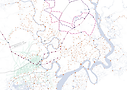
In an invited competition for the Highly Interactive Innovative Districts’ (HIID) large eastern extension of Ho Chi Minh City, the intelligent use of the region’s physical characteristics transforms the interfluvial area between Saigon and Dong Nai rivers into a climate change responsive territory.
The wide river basins of the Saigon and Dong Nai rivers (as well as the Vam Co Dong, Soai Rap, Long Tai rivers) are vast flood plains. The system results in a territory of an amazingly fine-mazed water system that covers more than 70% of the metropolitan area of HCMC.


Challenges of Climate Change and Flooding
All scenarios for HCMC of the National Target Program for Climate Change (NTPCC) indicate that substantial parts of the area will inevitably regularly flood (up to 4 meters above sea level by 2100).
The eastern area has already had dramatic transformation of its topography with extensive land-filling. Subsequent and planned development will fill vast areas by 2 (6500 hectares) or 3 (another 6500 hectares) meters of sand.
Innovative Urban Development Approach

The new project freezes the land manipulation in the state it is now and concentrates urban development on higher land or buildings on pilotis/stilts and opts for only high density. The urban development becomes an afforested archipelago in a mostly wet natural environment (in which amongst other native vegetation, mangroves are reintroduced where possible).
The conventional model of urbanization that replaces natural environments is inverted into a system where the urban is inserted within the natural—which is acknowledged for its self-renewing and healing (and hence sanitizing) qualities.
A New Vision for Water-Centric Urbanization
For the HIID of HCMC, this results in a radically new form of urbanity: simultaneously dense and distributed, solid and fluid. HIID is a water city where water structures urbanization, is the primary mode for movement, and introduces a way of settling with water-dominated landscapes.